“How lucky I am to have something that makes saying goodbye so hard.”
- A. A. Milne
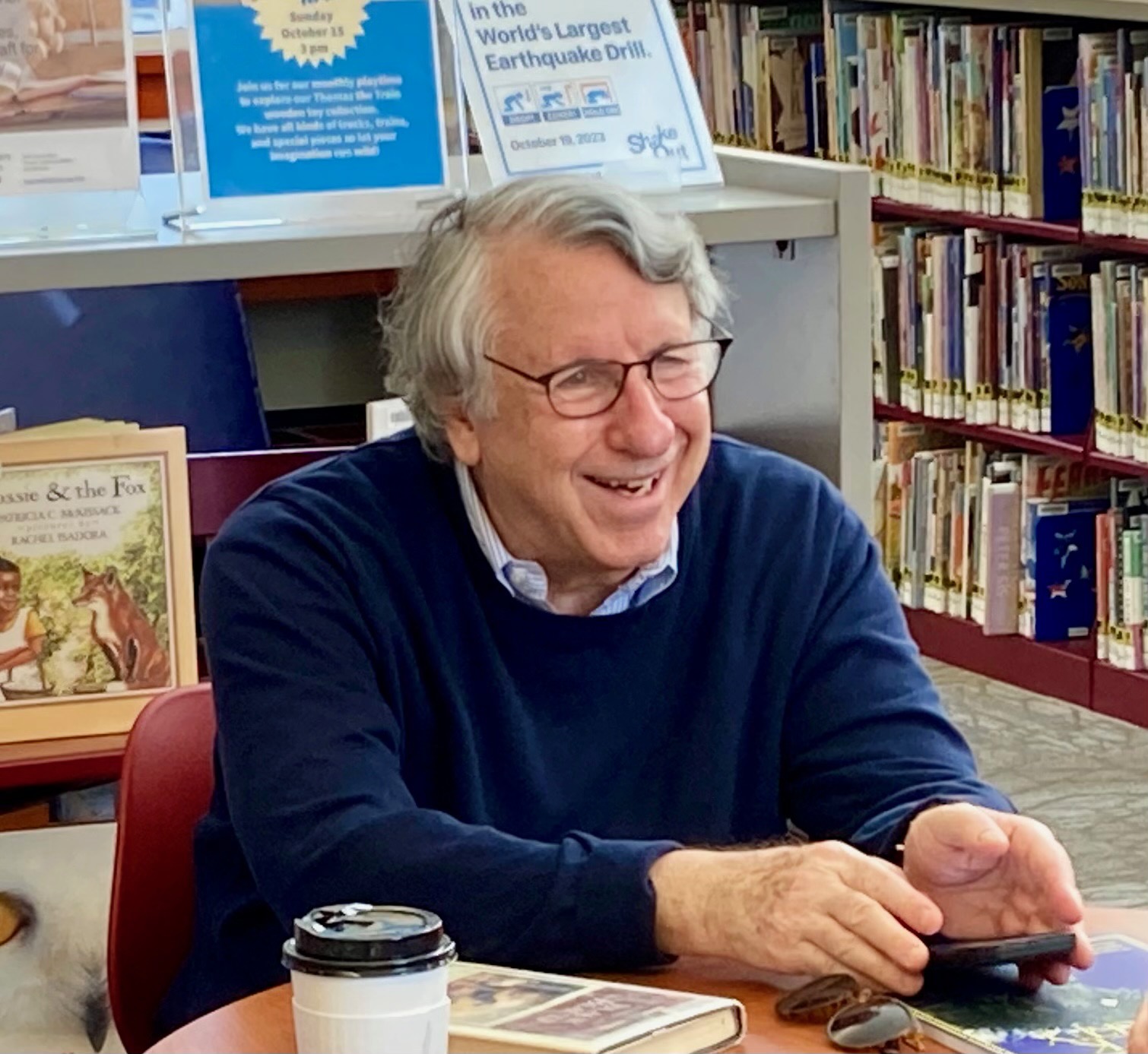
Sad News to Share: Jesse Kornbluth passed away peacefully on April 3, 2025
By
Published: Apr 07, 2025
Category:
History
You can read more about Jesse’s life and achievements here. Know that the 20 years that he was the creator of Head Butler — and your reactions to what he shared here — brought him such joy. If you want to share a memory of him, you can do so here on Facebook, or write his family using this address.
From the family of Jesse Kornbluth
Murray Dewart: Hammer and Tongs: Journal of an Artist and Sculptor
I have a problem reviewing Murray Dewart’s book. He’s been my brother’s best friend for 60 years. It’s possible I facilitated his marriage. I’ve spent a night in his guest room. I’ve reviewed his son’s media. But I want to tell you about the book. Solution: describe it, using no adjectives. A first. Here goes. Murray Dewart makes large public sculpture. His work is tinged with spirituality — his father was an Episcopal priest — and he has a religious commitment to art:
We pour all our energy and time and use up our stamina and wear out our eyes and our hands and our backs on the chance that the forms will come to life, that some sparking fire will keep burning in the stone cold form long after we are gone.
At the same time, he has an instinct for knowing what people who may not like sculpture respond to:
On New Year’s Eve, my bell installation on the Boston Common is finished and the response is astonishing, with a crowd of half a million people. At any one time, hundreds are waiting in line to ring the bells. In the heart of the city, I have set in place a simple bell ritual. Hour after hour there’s a palpable hunger and yearning in the upturned faces.
As a memoirist, he doesn’t spare himself:
At fifteen, in the library at Milton Academy, I had tried to talk James Taylor out of his plan for leaving school. What would happen to him as a high school dropout? About five years later, he was on the cover of Time Magazine. So much for my gift of prophecy.
There are many color photos. And practical advice, learned in China: “If you are being electrocuted, put your arms straight up so the electric current misses your heart.” There. No incriminating adjectives. To buy the book from Amazon, click here.
Books by Friends: Nicole Zeitzer Johnson, Daniel Asa Rose, Cort Casady, Stephen Saltonstall, Dori Salerno, Ann Medlock, Stephen Mo Hanan & Linda Condrillo
Nicole Zeitzer Johnson, illustrations by David Concepcion, “Joyfully Josie”
The story that Josie’s mother, Nicole Zeitzer Johnson, tells in this short, illustrated book is powered by a simple idea: children with disabilities can have rewarding friendships with children who have none. Josie can’t talk, can’t walk, can’t sit up without falling over. And yet, like other girls her age, “Josie loves music, sunny days, and playing with friends.” One more important fact about Josie: the more kids laugh, the more she laughs. So she has a big blue button to push — she can answer questions and signal agreement.
What’s Josie’s disability? FOXG1 syndrome. It’s rare – perhaps 1,000 people in the world have this gene glitch that affects brain development. When Josie was diagnosed, there was very little known about this syndrome, so Johnson teamed up with other FOXG1 parents to help children with this disorder experience life without suffering. The foundation they launched in 2017 now has a gene therapy program and hopes to be in clinical trials in the next few years.
We hear so much about “diversity” and “inclusion” and “acceptance” that these words have almost been bleached of meaning. Well, they’re fresh here. In just a few pages, Johnson banishes fear and resistance and normalizes disability. And there’s an information-rich website. This book is massively inspiring. [To buy it from Amazon, click here. For the Kindle edition, click here.]
Daniel Asa Rose: “Truth or Consequences: Improbable Adventures, a Near-Death Experience, and Unexpected Redemption in the New Mexico Desert”
In Daniel Asa Rose’s memoir, he and his best friend drive West, seeking adventure. It’s 1970. They’re 20. They’re driving a Land Cruiser they bought for $400. It has tires and a motor and not much else. Disaster looms, and in a small town in New Mexico — its name really is Truth or Consequences — it manifests: a reckless driver crashes into their car, and Dan goes flying. As he waits for an ambulance, a beautiful woman comforts him. Decades later, unmoored by the failure of his marriage, Daniel returns to New Mexico, looking to investigate what happened and thank that woman, but really to investigate himself. He’ll meet characters galore: a gun-toting AA group, a doctor awaiting change-of-gender surgery, and more. He also finds a situation he can change for the better — a moving ending that explains why Rose has won O. Henry and PEN Fiction Awards for his short stories. And why, this time, he lands on his feet. [To buy the book from Amazon, click here. For the Kindle edition, click here.]
Cort Casady: “Not Your Father’s America: An Adventure Raising Triplets in a Country Being Changed by Greed”
I can’t think of another classmate in the class of 1968 who started his TV career with the Smothers Brothers, and I’m 100% sure I don’t know another classmate who became, in 1995, the father of triplets. Now Cort Casady has written a memoir that’s about much more than parenting. “I wanted to write a book that would be a kind of open letter to our children. It would attempt to give them some context and perspective on the country they were born into, beyond the obvious ‘before Google’ or ‘before there were smartphones.’ I soon realized it would need to be an extremely long letter.” Not that long: 225 pages. The stories about the boys are charming. The stories about the US are, correctly, not: “In a country without guardrails, devastating things can happen.” What he learned passes for balance: “Don’t panic. Take one day at a time. Stay committed. Don’t give up.” [To buy the book from Amazon, click here.]
Stephen Saltonstall: “Renegade for Justice: Defending the Defenseless in an Outlaw World.”
His ancestor was a member of Harvard’s first graduating class. His cousin was headmaster of Exeter. His father was Harvard ’38, and after Exeter, it was assumed that Stephen Saltonstall would follow in the family tradition. Instead, he joined the Young People’s Socialist League and the Student Peace Union at Exeter and was expelled for holding a peace sign at the Memorial Day Parade. Somehow he was admitted to Harvard. We bonded at the college’s venerable literary magazine, where we impeached the editor in its centennial year, and were involved in a confrontation with Secretary of Defense Robert McNamara. Hey, it was the’60s.
Steve went on to the law school, which did not tame him. The title of his memoir says it all: “Renegade for Justice: Defending the Defenseless in an Outlaw World.” In his first case, he defended a serial killer. A cop killer followed. He tried to save the life of a fatally ill boy whose parents believed cancer could be cured with coffee enemas and Laetrile. Drug cases. Anti-nuke lawsuits. To paraphrase Reymond Chandler, trouble was his business.
His memoir begins: “This is a book of courtroom war stories, drawn from my forty years of experience as an obscure lawyer for the underdog and the downtrodden.” Don’t be fooled by his claim of obscurity. He handled important cases, and he tells their stories well — this is Grisham as non-fiction. This memoir is not a polemic. His aim is to recruit: “I hope my stories will challenge those of you — you know who you are, you who dream of soft landings in the glittering halls of boring, soul-free law firms doing the bidding of the uber-rich and powerful — to visualize the alternative, a career that’s built on cases and causes that further the public interest, human rights, and care of the natural world.” [To buy the paperback from Amazon, click here.]
Dori Salerno: “Mrs. Bennet’s Sentiments”
Doesn’t everyone love “Pride and Prejudice?” Really, it’s the favorite book of millions. Growing up, it was Dori Salerno’s. A few years ago, she reread it: “There was a section that seemed different this time around. Darcy was making fun of country families and Mrs. Bennet called him out on it, and her daughters disregarded her with the all-too-familiar eye-roll. But I thought, this mother is telling the truth. It made me think that maybe there was another reason for her to act the way she does besides just being ridiculous.” So she retold the story. This time around, Mrs. Bennet, agitated by menopause, sees clearly the grim fate that awaits her daughters if they don’t marry, and marry well. She’s sane and heroic, she rediscovers her talents, locates desirable suitors, and just generally kicks ass. Her “sentiments” are eye-opening and altogether delightful.
[To buy the book from Amazon, click here. For the Kindle edition, click here.]
Stephen Mo Hanan: “Scarpia’s Kiss”
It’s 1946, the reopening of La Scala, and the opera is “Tosca.” Samuel Krandall — born in Brooklyn as Samuel Kaminetzky — started his career as a cantor and is now the star baritone of the Met. In this opera, his first at La Scala, he is Baron Scarpia, “whose cynical, menacing lust both repelled and mesmerized.” His partner will be 25-year-old Miranda Baltazar. The scene they play out — the novel’s opening chapter — is thrilling. It takes you through a great opera performance, and more: it shows you how drama can inspire life, for the singers fall in love on stage. Pregnancy follows. He can’t leave his wife; she goes off to an isolated Caribbean island. At this point, the novel becomes an exchange of letters, not a great favorite here. But complications arise, and the resolution is dramatic, and at every turn Stephen Mo Hanan serves up tasty tidbits about opera and its practitioners.
[To buy the book from Amazon, click here. For the Kindle edition, click here.]
Ann Medlock: “Outing the Mermaid”
I know Ann Medlock as the Founder and Creative Director of Giraffe Heroes, which honors people who stick their necks out. It turns out she’s also a poet, a blogger, an editor, a speaker, an educator — and the author of an ambitious novel. Her book is a day in the life — or, better, a life in one day — of a woman whose marriage needed to die some time ago. Along the way, we revisit the cultural and political events of the 1960s and ‘70s. In the end, the put-upon wife does a simple thing, and you want to cheer.
[To buy the book from Amazon, click here. For the Kindle edition, click here.]
Linda Condrillo: “Period. The End: Wit, Wisdom, and Practical Guidance for Women in Menopause — and Beyond”
Linda Condrillo is not a doctor. And she doesn’t play one on the Internet. She’s a woman of a certain age, with her hot flashes behind her, and she’s written a wise, humane guide to surviving menopause. And did I say funny? The book is dotted with cartoons, recipes and the personal stories of survivors. “The change,” indeed!
[To buy the book from Amazon, click here. For the Kindle edition, click here.]
Lori Lieberman: From “Killing Me Softly” to “Truly”
Lori Lieberman is one of the writers of the classic “Killing Me Softly” — early proof she’s a singer-songwriter of uncommon sensitivity. Now she’s released “Truly.” Old songs? Why? Lori: “When I was a girl growing up in Switzerland, my father introduced me to all kinds of American music. He was an interesting character to say the least, with a dashing resemblance to Don Draper of ‘Mad Men’ and an insane zest for life. He was an inventor who loved the music of Bobby Short, Ella Fitzgerald, Frank Sinatra, and so many more. My childhood was chaotic and at times, difficult, but no matter what, our house was filled with that music, and my dad often told me he wished one day, I would sing some of those songs. To honor his memory, I wanted to make a record that would be easy on the ears, to attempt to calm the heart, and provide a moment of distraction. And I also felt compelled to re-record my ‘Killing Me Softly.’ as it is a story that is still unfinished.” In late October, 2022, I saw Lori Liberman do a set with a tight band. She played old songs I’d never heard, and I thought: ‘Joni Mitchell, Judy Collins — she’s the third of a small sisterhood.’ The obvious finale, “Killing Me Softly,” had women in the audience crying for reasons both universal and private.” [To buy the CD or MP3 from Amazon, click here]
The Beauty Part
Bon Iver. For the CD that started it all, click here.
Obligatory Blog Roll
- Blogs
- Hullabaloo
- Books
- Bill Gates
- Bookreporter.com
- Exotica
- Letters of Note
- Andrew Romano
- Finance
- Andrew Tobias
- Health
- Moms Clean Air Force
- Pamela Miles
- Intelligence
- Jenny McPhee
- Hive
- brainpickings
- Roughly Daily
- Charles Pierce
- James Fallows
- Media
- The New Yorker
- Music
- Speakers in Code
- Show Biz
- Roger Friedman
- Society
- New York Social Diary
- Spirituality
- Krishna Das
- Jeffrey Rubin
- Style
- Clé D’Or
- Designer Previews